
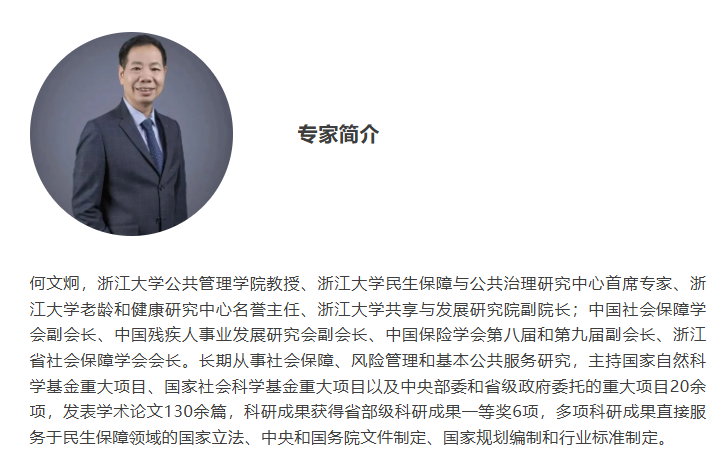
近日,中国社会保障学会副会长、浙江省社会保障学会会长、浙江大学民生保障与公共治理研究中心首席专家、浙江大学老龄和健康研究中心名誉主任何文炯教授接受《南华早报》采访,相关观点刊发于该报2026年9月1日深度报道“Looking out for the elderly”一文中,与读者分享。
Looking out for the elderly
The central government has announced plans to introduce a nationwide long-term care insurance scheme for the country’s rapidly ageing population by 2028, but uneven regional economic development and wealth distribution could be major hurdles
Wu Boyao was diagnosed with Parkinson’s disease 26 years ago. Now 86, he lives with his wife and one of their two daughters in a suburb straddling the border between Shanghai and Suzhou.
Originally from Shanghai, they moved to the area-which is administered by Suzhou-in search of a larger home. The trade-off was that Wu would no longer qualify for home care service sessions that were almost free.
A decade ago, Shanghai was one of the first cities in China to roll out a pilot long-term care insurance (LTCI) scheme. Wu, who by then was largely dependent on others for daily functionality, had his application approved.
The social security fund covered the lion’s share of the cost, leaving him with a token co-payment of just 6 yuan (HK$7) a session. In exchange, he received daily one-hour visits from a carer who helped with bathing, foot and nail care, massages and other tasks.
“It was a short service, but eased the burden for the family,” said his daughter Jenny Wu, who lives with him.
But because local governments’ financing and payment arrangements are separate, that arrangement ceased after the family crossed the municipal border, even though Suzhou has also been piloting its own LTCI system in recent years.
Wu is one of more than 40 million frail or cognitively impaired older adults in China, and among the first to use social insurance specifically designed for the needs of the country’s rapidly greying population. But coverage remains far from complete.
The LTCI programme is a governmentled system to cover the costs of daily living support and basic care for functionally disabled senior citizens. Funded jointly by individuals, employers and fiscal subsidies, similar models have been in place for decades in a handful of other countries, including Germany, Japan and South Korea.
After 10 years of pilot programmes spanning more than 90 cities, the central government announced in March that it would expand the initiative nationwide, establishing a system covering all residents by 2028.
While building a long-term care system could spur new industries, create jobs and boost consumption in a slowing economy, researchers say the country faces challenges that have yet to be fully confronted: a breakneck pace of ageing, stark regional economic disparities, and per capita GDP levels that remain a fraction of those in more developed economies.
Ensuring the fund’s sustainability and providing sufficient professional carers will also be headaches, they added.
“China is still in a phase of economic transition, with uneven development between regions and between urban and rural areas, and very uneven affordability,” said Wu Bei, a professor of public health and expert in gerontology at NYU Shanghai.
“While Shanghai may have a fair number of nursing homes and care facilities, it may be quite difficult to find one in the central and western regions, or rural areas,” she said, adding that caring for rural “empty-nest” seniors – those whose adult children have left home – presented one of the biggest challenges.
Last week, lawmakers incorporated language on LTCI into a Healthcare Security Law that will take effect from the beginning of next year, including a line saying the country will “establish and improve” a long-term care insurance system.
According to guidelines issued by the central government in March, payments for the nationwide system will be split between workers and their employers. For those without jobs, the costs will be covered by the individual and government subsidies. Once a contributor is assessed and certified as being in a state of disability for more than six months, they will be able to apply for insurance benefits to receive care services either in a nursing home or at home.
Only a small portion of contributors to the pilot schemes have benefited so far. They covered 308 million people around the country last year, but only 1.93 million received benefits, according to data released by the National Healthcare Security Administration in July.
China had about 36 million senior citizens with disabilities and 17 million with dementia at the end of last year, according to a report issued recently by the National Committee of the Chinese People’s Political Consultative Conference, the country’s top political advisory body.
That number is expected to surge as population ageing deepens. By the end of last year, there were over 223 million people aged 65 or older in China, accounting for around 16 per cent of the population, according to data from the Ministry of Civil Affairs. It is on track to become a “super-aged” society by the early 2030s, when those 65 or older will account for 20 per cent of the population, according to a United Nations estimate.
Globally, social insurance is not the mainstream model for providing long-term care for the elderly. Systems in northern Europe primarily rely on public finance supported by high taxation, with local governments responsible for the delivery of services. In the United States, a combination of public aid and commercial insurance is used.
He Wenjiong, a professor at Zhejiang University who specialises in social security, said it could solve some problems but could not be expected to solve them all, due to a lack of mature international experience and the absence of an “insurance gene” in Chinese cultural tradition.
“Our society lacks a culture of mutual aid,” said He, who took part in preliminary research on the LTCI system. “Many people prefer to save money and get back their principal with interest. But they’re not used to buying insurance-if they don’t get a payout, they feel cheated.
At the current, early stage, contribution levels are relatively low. A worker earning 10,000 yuan a month needs to pay 15 yuan a month, with their employer matching that amount, according to the central government’s guidelines.
For rural residents and unemployed urban residents, if the local per capita disposable income from the previous year was 40,000 yuan- close to the national average last year-the annual contribution is set at 60 yuan, split equally between the individual and government subsidies.
But He said even such seemingly low rates would be unaffordable for many rural residents, and called for full government coverage for those unable to pay.
In countries such as Germany and Japan, LTCI premiums are dynamically adjusted rather than fixed to ensure the insurance fund’s sustainability.

But sustaining these funds over the long term is no easy job. In June, Germany’s health ministry published a draft law designed to overhaul the system, which is facing a multibillion-euro deficit, with proposed changes including raising the contribution assessment ceiling for higher earners and imposing stricter qualification criteria for lower care levels.
“A few decades ago, we predicted that China would grow old before it grew rich,” said Wu of NYU Shanghai. “Today, we might say it’s at least growing old while growing rich.”
While noting that the system used in the US had its own problems, she said its idea of a multi-tiered, income-based safety net was worth learning from. Her research shows that in the US, public funding-primarily Medicaid and Medicare-accounts for nearly 70 per cent of long-term care spending, with commercial insurance covering about 10 per cent and out-ofpocket expenses making up the remaining 20 per cent.
Following a similar strategy, she said China should prioritise basic needs and direct more fiscal support to low-income families, while providing affluent households with diversified, personalised private insurance or high-end nursing homes.
She said another step China could take would be offering more support to family carers.
That could include the provision of adult day care centres, which would allow a family carer to work half a day instead of having to devote all their time to a disabled relative.
Jenny Wu said that was critical. As her mother-her father’s primary carer- gets older and weaker, she has had to take on
more duties.
“I quit my job before retirement age and now take flexible work at home for lower pay to care for my family,” she said.
Her experience since moving to the suburbs made her realise that at-home care services are, for now, still largely an urban privilege.
Though they could not use the LTCI system in Suzhou, the local government offered a separate subsidy programme that was similar in principle and covered both in-home and nursing-home care.
“But in reality, when I placed orders, no carer accepted them,” she said. “The suburbs are too far away-travelling an hour for a one-hour visit just isn’t worth it for them.
“For users, one hour is also too short. You still have to have someone home to open the door-disabled people can’t -and there’s not even enough time for the family carer to make a round trip to the supermarket.”
According to government data, China, with its tens of millions of disabled elderly people, had just 13,000 designated longterm care service institutions last year and 402,800 care workers.
Zhejiang University’s He said the government’s push for LTCI was partly intended to boost employment.
“There will be some kind of positive impact on the job market anyway-at least some people who could not afford a carer before can now hire one,” he said.
“But the jobs created are unstable and low-quality.”
Most people employed as carers nowadays were less educated and older than those in other fields, but some vocational schools had expanded elderly care programmes to bring in younger workers in recent years.
“In the long run, things will improve,” He said. “But in the short term, it’s bleak-many graduates leave their positions within a short time of being hired. Retention is relatively low. The work is demanding, but benefits are not proportional.”
That is an almost universal phenomenon.
In more than one-third of Japanese households where care was provided at home, both the carer and the care recipient were aged 75 or older-a phenomenon known as “elderly-to-elderly caregiving” -the country’s Ministry of Health, Labour and Welfare said last month, adding that this was a record high.
Despite all the challenges, Wu said ageing should not be seen only as a burden, arguing that for China it was also a strategic opportunity.
“If done right, it could professionalise the care industry, create many jobs, and boost economic development,” she said.
本文来源于:南华早报